
This section delves into the profound language of symbolism as a bridge between material reality and spiritual truth. It focuses on how universal archetypes manifest in religion and philosophy. The content illustrates the role of the Secret Doctrine in deciphering the esoteric meanings of mystical symbols. The content provides seekers with a clear framework to distinguish between mere intellectual form and the enduring divine wisdom reflected in symbolic expressions.
Table of Contents
- Symbols and Emblems
- The Mystery Language and Its Keys
- Primordial Substance and Divine Thought
- Chaos – Theos – Cosmos
- The Symbols and Glyphs of the Hidden Deity
- The Mundane Egg
- The Lotus
- Moon, Deus Lunus
- The Tree, the Serpent, and the Crocodile
- Demon est Deus Inversus
- Theogony
- The Four Elements
- Kwan-Shi-Yin and Kwan-Yin
- The Unity of the Primordial Tradition
- Adam – Adami
- Sanctum Sanctorum — the Holy of Holies
- The True Meaning of the Fallen Angel
- Pleroma
- Prometheus
- Enoch is the Keeper of Wisdom
- The Symbolism of Iao and Jehovah
- The Upanishads in Gnostic Literature
- The Cross and the Pythagorean Decade
- Mysteries of the Hebdomad (The Number Seven)
- The Deeper Meaning of the Study of Symbolism
Introduction
While the first part of Volumes I and II of the ‘Esoteric Doctrine’ deals with the archaic stanzas of the ‘Book of Dzyan’ (or ‘Stanzas of Dzyan’) and their commentaries, the second part of each volume serves as the necessary methodological bridge. Here, the purely abstract, metaphysical contemplation of the origin of the world (cosmogenesis) and the origin of humanity (anthropogenesis) transitions into a universal, sacred visual language which is then deciphered.
Theosophical philosophy teaches that the deepest mysteries of nature and the spirit cannot be revealed to an untrained, uninitiated mind in rigid, dogmatic forms, but have been conveyed and safely preserved in universal symbols and ideograms since the dawn of humanity. This was not primarily done for the sake of deliberate obfuscation, but because the deepest truths of metaphysics exceed the capacity of the purely linear intellect.
Symbols are fractal and holographic in structure, with the great reflected in the small. Understanding this is the ‘key’ without which systematic cosmogenesis and anthropogenesis remain impenetrable. In a sense, Blavatsky presents the seeker with the alphabet of the soul, without which esoteric philosophy remains silent.
The overview we can provide here is only a small fraction of what is written about it in The Secret Doctrine. Therefore, this text serves as an introduction to, and a guide for grasping the structure, themes and immense spiritual relevance of this book. It also prepares the mind to decipher the veiled truths of archaic science independently. Furthermore, it forms the basis for our in-depth study of the individual topics.
Universal Symbols (Cosmogenesis)
First, we provide an overview of the second part of the first volume of The Secret Doctrine, titled ‘The Evolution of Symbolism in its Approximate Order’. We then move on to the evolution of symbols in the human world in the second part of Volume II, titled ‘The Archaic Symbolism of the World Religions’.
The treatise on the evolution of symbols is not an arbitrary collection of ancient myths. Rather, it follows a mathematical and occult order that traces the gradual descent of the spirit into matter, as well as providing a blueprint of the cosmos. H. P. Blavatsky presents this panorama in a systematic way.
"A symbol is ever, to him who has eyes for it, some dimmer or clearer revelation of the God-like. Through all there glimmers something of a divine idea; nay, the highest ensign that men ever met and embraced under the cross itself, had no meaning, save an accidental extrinsic one." (Carlyle)
Symbols and Emblems
Right at the outset, Blavatsky posits that not a single ancient myth is pure fiction; rather, they all have genuine historical, scientific and metaphysical bases. She defines a symbol as an ’embodied thought’, a synthesis that connects the invisible divine with the visible physical world. The fatal error of orthodox theology and materialistic science is to take ancient writings literally, becoming enslaved to the dead letter in the process.
An esoteric symbol is like a multifaceted diamond: its individual facets allow for various interpretations while simultaneously referring to different occult and physical sciences. Thus, an ancient priest could express astronomical, physiological and psychological laws through a single symbol.
For the purposes of this study, it is important to define the subtle difference between a symbol and an emblem. A symbol generally illustrates a single, specific idea. An emblem, on the other hand, encompasses a broader chain of thought. It usually consists of a series of graphic images that unfold an idea allegorically and present it in panoramic scenes, one after another.
Exoteric writings such as the Hindu Puranas or the Bible are examples of emblems. To the untrained eye, archaic symbols and emblems may appear meaningless, but to the trained eye, they reveal a comprehensive body of the deepest philosophical teachings.
The Mystery Language and Its Keys
This symbolism is not a recent invention, but rather a remnant of the so-called ‘language of the Mysteries’ from prehistoric times. Originally, this language was purely pictorial and symbolic, rather than phonetic. It is important to understand that this system did not evolve randomly, but was handed down to early humanity by a far more advanced humanity from earlier cycles.
The language of the Mysteries touches upon the absolute foundation of occult hermeneutics. Blavatsky guides serious seekers to the inescapable realisation that no theology in the world arose independently. Each of them — from the oldest traditions to the most recent dogmas — springs from this one common source: a single universal esoteric language. This language forms the basis of all ancient hieroglyphs and sacred scriptures. This knowledge is an indispensable compass that prevents students from becoming trapped in the illusion of material and exoteric dogmas, or the ‘dead letter’.
A key concept here is the multiplicity of interpretation. The mystery language of the hierophants does not have a single, one-dimensional level of meaning, but rather branches out into seven ‘dialects’, or ‘keys’.
Each of these interpretive keys relates to one of the seven great mysteries of nature, unlocking its own level of reality: astronomical, anthropological, physiological, psychological, theogonic, spiritual and anthropogonic.
Only by learning to apply these keys in their entirety according to the occult method of analogy can one read and comprehend nature in all its fullness rather than viewing it through an isolated and thus distorting lens. A symbol such as the ‘egg’ or the ‘serpent’ can describe cosmic genesis, planetary cycles and human physiology simultaneously.
No exoteric sacred text in the world contains all of this knowledge. Every ancient religion is merely one or two chapters of the complete archaic text. Only Eastern esoteric science can claim to possess the complete secret, along with its seven keys. While comparative studies are useful, ultimately it is up to the trained student’s intuition to piece together the remaining fragments.
Understanding these ancient symbols relies heavily on geometry and numerology. The cross, the circle and other archaic symbols play a prominent role in cosmogony. Interpreting ancient texts correctly using mathematical, geometric and numerical keys is not a matter of mere speculation or pure chance.
Blavatsky proclaims that applying the already rediscovered keys consistently to the Holy Scriptures will irrevocably kill the ‘dead letter’ of the Bible and all other exoteric faiths. Blind faith will then be replaced by knowledge, as the ancient dogmas will be revealed in all their naked truth.
Primordial Substance and Divine Thought
Under this title, HPB reveals the metaphysical foundation upon which the entire manifested universe rests. Modern science and orthodox theology often fail due to the apparent gulf between spirit and matter; one denies spirit, while the other condemns matter. However, esoteric philosophy bridges this divide, revealing that spirit and matter are not separate realities but two inseparable aspects of one absolute reality.
It teaches that spirit is best understood as cosmic ideation and matter as cosmic substance:
“In modern language, the latter would be better named COSMIC IDEATION ― Spirit; the former, COSMIC SUBSTANCE, Matter. These, the Alpha and the Omega of Being, are but the two facets of the one Absolute Existence”.
In this quote, we recognize the cosmic origin of the division into Alpha and Omega, which the Maha Chohan referenced in relation to humanity. We have confirmation that spirit and matter—Alpha and Omega—are not separate from one another but rather two aspects of one absolute reality. Therefore, our task is to reflect this cosmic harmony onto the human plane.
The divine thought, in its pure abstraction, is incomprehensible to the finite mind. It can only be grasped spiritually through the countless forms of substance in which it manifests. All consciousness, whether reflexive, direct, or unconscious and purposeful intention in nature, originates from spirit. In contrast, matter is the purest abstraction of objectivity. It forms the self-existent basis whose seven differentiations constitute objective reality for every phase of conscious existence.
Ether, Akasha, and the Womb of Creation
Blavatsky cautions against equating this primordial substance with the physical ether of modern science. This primordial substance is the original chaos of the ancient sages: a mysterious, spiritual ether containing the seeds of all cosmic creation within itself.
In the mystery schools, this highest ether is called Akasha (Akâsa). It is the heavenly virgin and the untouched mother of every form and being. Only when the Universal Spirit hovers over these waters and “fertilizes” them do matter, life, power, and action enter manifest existence.
In ancient philosophy, as with Anaxagoras, people were aware that the spiritual prototypes of all things were generated in this boundless ether, developed from it, and returned to it. It was only in later, degenerate ages that this sublime, abstract concept was personified and humanity began to worship a personal creator god and a heavenly virgin.
In this section, we recognize the themes of the Maha Chohan Letter, which deals with the concept of a personal god and the common origin of religions and myths.
The Microcosm: The Ego and Its Vehicle (Upadhi)
What takes place in the macrocosm is reflected in human consciousness. The primordial substance serves as the basis, or vehicle (upadhi), for every conceivable phenomenon, whether physical, mental, or psychic. When the cosmic idea focuses within this principle, our individual ego consciousness arises from it.
Thus, the purity and permeability of our vehicle—our lower sheaths—determine how much divine light can penetrate our daily consciousness. This confirms the insight that purifying the lower quaternity opens and expands the Antahkarana bridge, which connects us to the higher divine trinity.
Chaos – Theos – Cosmos
The following chapter explores the synthesis of spirit and matter in greater depth. The untrained mind tends to view chaos, the divine, and the ordered universe as three distinct phenomena. Theosophical teaching corrects this error fundamentally. Chaos, the divine, and the ordered universe are, in truth, merely three aspects of an ultimate synthesis: Space.
However, this Space must not be confused with the empty, abstract void postulated by modern science. Rather, it is the “unknown container of all,” the unknown first cause. Due to its boundless nature, this space is the actual body of the universe and its seven principles. In eternity, Chaos, Theos, and Cosmos are identical to this one unknown space.
To understand the formation of the worlds, the ancient understanding of “Chaos” must be restored. Chaos does not mean mere disorder or confusion. In Hermetic, Orphic, and Pythagorean cosmogonies, Aether (or Æther) and Chaos—or Spirit and Matter in Platonic terms—represent the two original, eternal principles of the universe. Chaos is the formless, fluid principle: primordial matter without form or meaning. It is often referred to as the great “Deep” or the primeval waters. Aether, or Spirit, on the other hand, is the all-animating intellectual principle. During the initial phase of cosmic reawakening, Spirit silently hovers over the face of this future, boundless creation.
As soon as the Spirit unites with Chaos, the formless principle takes on meaning and “shines with joy.” From this union comes the firstborn Light, Protogonos. Here, Theos appears. Theos is the divine, formative intelligence comparable to the Hindu Brahmâ, who emerged from Chaos or the great waters. Theos is the first triangle, or the Pythagorean triad, arising from the union of unfathomable spirit and formless matter. The inevitable result of this alchemical act is the cosmos: a harmoniously ordered, manifested universe.
In this chapter, we learn that the triune deity “Chaos-Theos-Cosmos” is the “All in All.” It encompasses the entire spectrum of opposing qualities: male and female, positive and negative, good and evil. During cosmic periods of rest (Pralaya), the Trinity remains hidden and latent; it is an unrecognizable deity. However, as soon as it transitions into its active functions, it manifests in the visible world as matter, force, and living spirit. Comprehending this sublime Trinity as an inseparable unity causes anthropomorphic idolatry to fall away, allowing us to recognize the complete, indivisible vitality breathing in every atom of nature, just as in our own immortal soul.
The Symbols and Glyphs of the Hidden Deity
The absolute foundation of occult theogony is the realization that the supreme deity is not a manifested “god” in the human sense. When theosophists and occultists declare that God is not a Being but a “No-Thing,” they show far greater reverence for the Divine than those religions that call God “He” and thus degrade Him to a gigantic, limited Male.
In the archaic Jewish Kabbalah, this hidden unity is called Ain Soph—the unfathomable, boundless, and nameless.
To our finite minds, it is pure darkness. The unchanging infinite and absolutely boundless cannot will, think, or act in its homogeneous essence. To do so, it must become “finite.”
This hidden deity (Ain Soph, Parabrahm) is symbolized by a boundless circle or absolute darkness from which the infinite First Logos emerges as a point.
The Mundane Egg
Why did the ancient hierophants choose the egg as the vessel for their deepest knowledge? According to Blavatsky, the egg represents the origin and mystery of existence in the most perfect and vivid way. We are looking at a closed, seemingly lifeless structure. Yet, unseen within it, the miracle of evolution unfolds: the hidden seed gradually and organically develops, driven by an inner, invisible force. From the outside, all it needs is warmth to finally break free from the shell and emerge as a living being. From the beginning, it must have been a true miracle.
What the circle and the point represent in the boundless, abstract subjectivity of Pralaya (cosmic rest) is the World Egg with its divine seed in the emerging, physical objectivity of Manvantara (cosmic activity). The point within the boundless circle represents the unmanifested Logos on the highest metaphysical plane. Within the World Egg, however, it transforms into a triangle through cosmic gestation, becoming the manifested Logos.
The egg itself represents newly differentiated cosmic matter, the “womb” or primordial chaos in which the vital, creative seed receives its first spiritual impulse and awakens from pure potentiality to active power. Thus, the “God” who formed the physical universe is never the Absolute itself, but always only a subordinate, finite reflection.
The tragedy of modern religions, particularly later Judeo-Christian theology, is that they have personified these profound emanations, such as the Sephiroth. True esoteric philosophy does not, however, regard these personified powers as creations out of nothing but as the many aspects and emanations of the one sole manifestation of the Absolute.
The egg is one of the most comprehensive symbols of the germination of the universe and planetary chains. It also represents the cycle of periods of rest (Pralaya) and activity (Manvantara), known as the days and nights of Brahma.
This esoteric philosophical symbol is found in Indian, Egyptian, Norse, and Greek cosmogonies.
The Mundane Egg shows us that knowledge of inner cosmic laws and evolution is the common heritage of humanity across all geological and historical cycles. However, for the true seeker on the theosophical path, this symbol is more than ancient cosmology; it is a constant reminder of the alchemy of one’s immortal soul. Enveloped in the dense shell of matter—the physical body and personality—the eternal seed (the Monad) matures through spiritual warmth until the shell of limitations and illusion (Maya) shatters, awakening the divine human in radiant, universal freedom.
The Lotus
In ancient traditions, particularly in India and Egypt, the lotus (also known as the water lily) is a universal symbol representing both the cosmos and humanity. In theosophy, the lotus is considered the perfect symbol of evolution. Its roots rest in the dark mud of matter, its stem grows through the waters of the astral world of form, and its flower blooms in the pure air beneath the spiritual sun.
Metaphysically, the lotus is a dual symbol of the feminine because it carries its own seed and represents the matrix of all things. From this androgynous, universal nature emanate the masculine creative forces. In Hindu cosmology, the lotus contains Brahmâ (the universe) and grows from the navel of Vishnu. This symbolizes the central point in the waters of infinite space.

Moon, Deus Lunus

While modern science views the moon as merely a lifeless rock, esotericism reveals its immense occult connection to procreation, the cycles of creation, and humanity. Nearly all mythologies associate moon goddesses with birth because the lunar influence affects a woman’s ability to conceive. However, modern physiology dismisses this fact as superstition.
“No symbol—the sun included—was more complex in its manifold meanings than the lunar symbol.”
The occult anthropology of India and Egypt teaches that our physical bodies originate from lunar ancestors called Pitris. This topic is also addressed in the section on anthropogenesis in The Secret Doctrine.
The Tree, the Serpent, and the Crocodile
The Tree of Knowledge and the serpent are inseparably linked. In ancient philosophy, the serpent was not a symbol of absolute evil but rather represented divine wisdom, psychological regeneration, and immortality. Hermeticists and initiates throughout the ages have called the serpent the most spiritual being of all. In Hinduism, Sesha or Ananta is the symbol of infinity.
The macrocosmic tree is the universe itself, in whose branches the serpent of eternity dwells. The microcosmic tree, on the other hand, is the human being in whom the conscious, thinking principle (Manas) resides as the “serpent of manifested wisdom.” It was not until the Middle Ages that theology degraded the serpent into the devil, thus making it a pure symbol of evil. Early Christians and Gnostics recognized the dual Logos: the good serpent (Agathodæmon) and the evil serpent (Kakodæmon), or spirit and matter.

The crocodile, known as Makara in the Indian tradition, joins this symbolism as another cosmic animal. In the Egyptian Book of the Dead, the crocodile is closely linked to the struggle between spirit and matter. It represents the chaotic and impetuous forces of disorder, referred to as the “sons of rebellion,” that must be brought into order by the sun gods. Elsewhere, the soul exclaims: “I am the crocodile whose soul comes from humans.” This suggests a profound occult connection between animal instincts and the latent human intellect. By understanding these symbols, we see that ancient peoples were not blind idolaters or primitive nature worshippers.
Each ideogram is like a multifaceted diamond, reflecting cosmogony, anthropology, physiology, and spiritual psychology simultaneously. Those who approach the symbols with the appropriate knowledge and intuition recognize the indelible family tree of their soul within them.
They understand that the spirit’s descent into earthly procreation and the conscious mind’s struggle were not a “fall from grace,” but rather the heroic drama of self-knowledge. One day, they may rise from the waters of illusion, immaculate as the pure lotus.
Demon est Deus Inversus

Studying “Demon est Deus Inversus” has profound psychological and ethical implications for students. It frees us from the paralyzing fear of an external, sinister power. Esotericism shifts this mighty struggle back to where it belongs—within the human heart. If the metaphysical principle “Demon est Deus inversus” has its cosmic foundation in the dual nature of spirit and matter, then it has its sole practical application in humanity.
Through separation, egoism, and ignorance, we ourselves give birth to the demons. The devil dwells in our lower mind, chained to matter. Those who understand this universal symbolism no longer see the path of self-knowledge as an escape from abstract evil. Instead, they view it as the alchemical task of transmuting the shadow within us through the light of the soul. They see it as leading the restless striving of matter back into the conscious harmony of the spirit.
Theogony
Rather than a personal, extra-cosmic creator god who creates from nothing, the Esoteric Doctrine teaches of a collective creative force. In place of a solitary creator, there is theogony: the doctrine of the becoming of the gods. These gods are not idols to be worshiped; rather, they are intelligent forces of nature known as the Dhyan Chohans, or the “Hosts of Light.” They are personifications of the laws of the universe and act within the framework of karmic necessity.
Thus, the universe is not “created,” but rather unfolds from the Logos, the revealed Word or Mind. However, this Logos is threefold:
1. The unmanifested Logos (the first symbol of the Unknowable).
2. The semi-manifest Logos.
3. The manifest Logos, which appears as the totality of the seven creative powers.
This septet is found in all religions. For example, it is the Elohim of the Hebrews, the Amshaspends of the Persians, and the Rishis of the Hindus. Blavatsky clarifies that these beings are the actual “architects” of the cosmos. They differentiate themselves from the unity of the Pleroma (the Fullness) into the diversity of material worlds.
These gods or energies do not possess arbitrary power. Rather, they are reflections of Ideation (the divine realm of thought), which acts upon Mulaprakriti (primordial matter). Thus, the gods are both the result and the instruments of cosmic evolution.
The creative gods operate on various levels:
- On the formless (arupa) level, they act as pure intelligences.
- On the formed (Rupa) level, they act as the forces that organize elements and physical matter.
A particularly profound idea in this chapter is the identity of humans and God. The creative powers that create the cosmos are the same principles that lie dormant within humans as Manas (the thinker) and Buddhi (the spiritual soul). The path to self-knowledge inevitably leads to an understanding of this inner theogony. We are part of this creative hierarchy, which has unfolded toward perfection throughout the eons.
Our human existence is not a product of chance but rather the culmination of an evolutionary chain spanning eons. We carry within us the elements of all seven creations, from the universal mind (Mahat) to physical form. Understanding this “theogony of creation” is key to grasping one’s responsibility within the cosmic fabric. The cycle of being is fulfilled in humanity, whose stream of consciousness is directed “downward” into matter to spiritualize it. We are called to consciously continue the work of the cosmic “builders.”
The Four Elements
For occultists, the elements of earth, water, air, and fire are not just states of matter or physical substances; they are the visible forms of cosmic hierarchies and spiritual beings. The Dhyan-Chohans and hosts of elementals stand behind each element and function as the “builders” of the manifested universe.
A central doctrine is that the elements gradually manifest over the course of the seven rounds of our Earth chain. Each round brings a new element into its perfected material form.
1. In the first round, fire (light) was developed. However, it was a “cold, luminous fire,” a kind of gaseous light that had nothing to do with our burning flame.
2. In the second round, air was brought forth—the “breath of the upholders of the firmament.”
3. In the third round, water was formed, the primordial fluid necessary for the formation of a “living soul.”
4. The fourth round (our present one) manifested the Earth with its hard, solid crust.
Blavatsky points out that we will only experience the fifth element, ether (the gross material body of Akasha), as a universally perceptible fact of nature in the fifth round, just as we experience air today.
The evolution of the elements runs parallel to the evolution of human perception. Each element corresponds to a sense and a property of matter:
- Fire corresponds to sight.
- Air corresponds to touch and hearing (through sound).
- Water corresponds to taste.
- Earth corresponds to smell.
The physical senses are based on the tanmatras, or the subtle potentials of the senses. The chapter clarifies that our current perception of the elements only captures their “shadow side.” The dense matter of the fourth round is a kind of Maya, or illusion, that veils the true nature of the elements.
Above the four manifested elements stands Akasha, the immaculate “Mother.” It is the Pleroma, the space that contains everything and the primordial element from which the others develop through differentiation, or emanation. It is the upadhi, or vehicle, for the divine mind. The “four elements” are the “Sacred Four,” forming the basis of the Pythagorean Tetractys. Those who understand the nature of these elements understand the laws of their own constitution. After all, man is a microcosm composed of the same “Fiery Lives” as the universe itself.
Studying the elements leads one from merely observing the phenomenal world to knowing the spiritual causes that operate behind the veil of matter.
Kwan-Shi-Yin and Kwan-Yin
In Asian symbolism, the teachings on the primordial symbols culminate in Kwan-Shi-Yin, the masculine aspect of the Logos, and his feminine counterpart, Kwan-Yin. Kwan-Yin is the divine voice, or Vâch, representing grace and compassion. She is the bridge between formless spirituality and illusory material creation. She is the power of mystical sound and the word that translates formless cosmic thought into objective reality, such as stars and atoms. These two aspects represent the universal Logos.
„Kwan-Shi-Yin is the ‘Voice’ or the ‘Word’ . . . and Kwan-Yin is the ‘Melodious Voice’ or ‘Sound’.“ (SD I)
In esoteric philosophy, they correspond to spiritual light and sound. They are Shakti, the feminine active energy, and its source. Without Kwan-Yin, the feminine principle representing space or matter in its subtle state, Kwan-Shi-Yin, the creative spirit, could not take form.
Blavatsky identifies Kwan Shi Yin as the esoteric counterpart to Avalokiteshvara, the Lord Who Looks Down. He is the Logos that permeates and watches over the universe simultaneously.
This principle is crucial for self-knowledge because the Logos in the cosmos is identical to the Atman, or the highest Self, in human beings. When we hear the voice of Kwan-Yin within—which Blavatsky later refers to as the “Voice of Silence”—we come into contact with this universal consciousness.
Kwan-Yin is a goddess of compassion and represents Akasha, the world ether, in its capacity as the carrier of sound. She transforms divine thought into audible and visible manifestations.
For the path of self-knowledge, this means: Every word and thought is an act of creation, subject to the laws of Kwan Shi Yin and Kwan Yin. We act as small creators within this great hierarchy.
At the highest level, the separation between “God” and “human,” or “male” and “female,” is dissolved. Kwan-Shi-Yin and Kwan-Yin are the eternal dual aspects through which the one consciousness experiences itself.
Those who deeply understand the teachings of Kwan Shi Yin recognize that the compassion of which the Maha Chohan speaks is not just an emotion; it is a cosmic law that holds the universe together while forming a bridge between formless spirituality and illusory material creation. Through the feminine aspects of compassion and grace (Kwan-Yin), one can achieve union with the highest spirit. This highest union is personified by the Bodhisattvas, the Buddhas of Compassion.
We will now turn our attention from the symbolism of the macrocosm to the microcosm, the human being.
(Blavatsky)
Symbols in the World-Religions (Anthropogenesis)
The transition to the second volume, Anthropogenesis, is more than a change of subject; it is the continuation of the evolution of symbols and the consistent application of the occult law of analogy, “As above, so below.” This is evident in the fact that the section on symbolism in Volume I ends with Chapter 15, while the section on symbolism in Volume II begins with Chapter 16. While Cosmogenesis presents the blueprint of the temple, Anthropogenesis tells the story of the living God who inhabits this temple-in-the-making.
While “BOOK I. Part I” deals with the macrocosm, the origin of the universe, and the abstract, universal forces of space, time, and matter, “BOOK I. Part II” – Part II” shifts to the microcosm and humanity (anthropogenesis). Here, we see how cosmic symbols take concrete form in the history of humanity and the root races. These themes are the anthropological counterpart to the vast macrocosmic processes outlined in Volume I.
In “Book II. Part II: The Archaic Symbolism of the World Religions, Helena P. Blavatsky reveals that the history of humanity extends beyond the scope of modern historiography and anthropology. While science regards humans as a kind of higher animal, Esoteric Doctrine reveals humans as fallen deities—monads, or indivisible divine units—that have embarked on a long journey through matter to attain individual self-consciousness.
Blavatsky emphasizes that this process did not occur by chance. A decisive moment in human evolution was the incarnation of the Manasaputras, or the “Sons of the Mind” or “Sons of the Intellect.” Without the spark of Manas, or the human intellect, the physical body would remain an instinct-driven shell (see Anthropogenesis, fourth round, fourth globe, and third root race).
The second part of the second volume is devoted to presenting evidence. Blavatsky demonstrates that the true origins of humanity are “hidden” in the archaic symbols of world religions. These symbols are not arbitrary inventions but rather the scientific stenography of adepts from earlier root races.
In this section, we will examine how myths such as the “Fall,” “Lucifer,” and the “War in Heaven” encode universal esoteric truths. Blavatsky urges us to strip away the exoteric veils to uncover the core of Gupta Vidya, secret knowledge.
We will enter a world where the cross, the circle, the serpent, and the Tree of Life reveal their true anthropogenetic significance. We will realize that the gods of antiquity were not merely personifications of natural forces but also memories of the spiritual hierarchies that guided humanity in its early stages of development.
This part of the teaching invites us to view the history of humanity not as a linear ascent from primitive to complex but as a cyclical process of spiritualizing matter. It is the journey of Purusha (the spirit) reflected in Prakriti (matter) to ultimately awaken as a perfected, self-aware creator.
The veils of religious dogma are lifted so that we may recognize archaic symbolism for what it is—the chronicle of our divine origin and our path back to unity.
The Unity of the Primordial Tradition
Blavatsky begins with the irrefutable assertion in the esoteric sciences that there was once a single universal religion of wisdom. Today, this religion is reflected only in fragments of the world’s scriptures. Blavatsky emphasizes that no scripture, be it Genesis, the Puranas, or the Egyptian Books of the Dead, stands alone. All draw from the same source: the Gupta Vidya, or esoteric science.
She makes it clear:
„The Secret Doctrine was the universally diffused religion of the ancient and prehistoric world. Proofs of its diffusion, authentic records of its history, a complete chain of organised documents, showing its character and presence in every land, together with the teaching of all its sages, exist to this day in the secret crypts of libraries belonging to the Occult Fraternity.“
For the Path of Knowledge, this means that the path lies not in inventing new teachings but in reconstructing this archaic truth through comparative symbolism. As in the first part, the seven keys must also be applied here to arrive at the truth. Sacred scriptures describe the history of the “descent” of the Spirit into matter and the subsequent ascent. However, this process has often been misunderstood as a “battle in heaven” or the “Fall of Man.” In truth, it is anthropogenesis: the incarnation of divine monads into physical forms.
The “confirmation” of esoteric teachings in every scripture assures students that they are not following a modern invention but rather the Sanatana Dharma, the eternal order that has existed since the beginning of time.
Adam – Adami
The first symbol examined in Anthrophogenesis is Adam. It becomes clear that searching for the true “Adam” is synonymous with searching for one’s own spiritual lineage. Adam-Adami is the key to understanding the connection between the divine idea and physical manifestation.
In short, this symbol represents the idea that humanity did not descend from a sinful couple but evolved from an ancient process in which the “Heavenly Man” gradually enveloped himself in matter to ultimately attain self-knowledge. The details are presented in depth in the section “Anthropogenesis.”
The “Adam-Adami” symbol is not a mere invention but a multifaceted symbol with origins in Aryan thought that was later adopted by Semitic and Turanian peoples. Esoteric philosophy teaches that “Adi” (the First) was the name the Aryans gave to the first speaking race of humanity. Terms derived from this include Adonai (the Lord), which the Jews applied to their Jehovah and the angels—originally the spiritual and ethereal sons of the Earth.
In the teachings of the Chaldean sage Qû-tâmy, Adam-Adami is a personification of the dual Adam.
- Adam Kadmon is the paradigmatic, creative “Heavenly Man.”
- The lower Adam is the terrestrial man who, according to the Syrian view, initially possessed only nephesh (the breath of life) but not a living soul.
The Kabbalah also speaks not of a single human being but of four different Adams who represent successive human transformations or root races. These Adams are emanations of the Dyooknah, the divine phantom of the Heavenly Man. They represent our five races.
Sanctum Sanctorum — the Holy of Holies
Blavatsky begins by explaining the universal nature of the Sanctum Sanctorum, also known as the Holy of Holies. This concept was present in all ancient mysteries, from the Egyptian adytum to the sacred sites of the Hindus. It represents the Pleroma, or the unmanifested space from which all life emerges. In archaic symbolism, the Holy of Holies was the place of spiritual rebirth and, in a purely cosmogonic sense, symbolized the womb of nature in which the divine Thought came into manifestation.
Blavatsky points out that what was once an astronomical and metaphysical truth degenerated in later Semitic and exoteric religions into purely phallic and generative symbolism. She sharply criticizes the fact that modern theology and even parts of science now reduce these symbols solely to their physiological level.
Thus, the Adytum, which originally represented boundless space, became the Ark (or Argha)—a vessel that preserves the seed of physical life in the exoteric understanding.
Deeper mathematical laws underlie the Holy of Holies, particularly the problem of squaring the circle. The cube, the shape of the Ark or the Holy of Holies in many temples, represents the manifested fourth dimension, or matter; the circle, or sphere, represents the unmanifested spirit. Therefore, the degradation consists of worshipping the “God in the cube” (the physical human being or generative force) instead of the “Spirit in the circle.”
Serious students must not seek the “Holy of Holies” in external temples or physical symbols, but within. They must distinguish between the spiritual Logos and the generative God. They must recognize that symbols such as the Ark or the Cross were originally cosmic maps before becoming dogmatic idols. One must lead one’s consciousness out of the “cube” of matter and back into the “circle” of the infinite Spirit. One must break through the “shells” of exoteric religions to return to the pure, unblemished source of truth—the true Sanctum Sanctorum, which exists as a divine spark in every human heart.
The True Meaning of the Fallen Angel
The chapter “On the Myth of the Fallen Angel, in its Various Aspects” addresses one of the most misunderstood and theologically distorted topics in religious history. It deconstructs the ecclesiastical dogma of the “evil devil” and reveals the deepest esoteric truth about the spiritual origin of humankind.
According to esoteric teachings, the “Fall of the Angels” does not represent a moral failure or rebellion against a supreme deity. Rather, it is a cosmic sacrifice. The “fallen angels” are actually the Manasaputras (Sons of the Mind) or the Agnishvatta-Pitris (Fathers Purified by Fire). In Anthropogenesis, this section deals with the third root race. It emphasizes that these beings refused to “create” purely instinctive, soulless shells but instead waited until the human form was ready so they could incarnate into these forms. Thus, the “Fall” is the descent of the spirit into matter for the purpose of evolution.
Lucifer
A central and often provocative aspect of this chapter is the interpretation of the term “Lucifer.” Blavatsky traces the word back to its original meaning, lux ferre, which translates to “bringer of light.” In an esoteric sense, Lucifer is not an evil demon but rather a symbol of humanity’s awakening self-awareness and spiritual independence.
She explains that the serpent in the Garden of Eden and the fallen angel are identical to the principle of Manas, or intellect. It was only through this “fall” into the knowledge of good and evil that humanity became morally responsible. Without Lucifer, humanity would have remained a flock of “soulless automatons.”
The War in Heaven
Both the Book of Revelation and the Indian wars between gods and asuras depict the “War in Heaven.” This war is actually a depiction of the struggle between spiritual intuition and intellectual reason, as well as the transition from formless to physical existence.
The asuras, often mistakenly referred to as demons, stand above the devas in the esoteric hierarchy because they represent the intellectual power necessary to master matter.
The Dragon as a Symbol of Wisdom and Eternity
In Christian iconography, the dragon is almost exclusively associated with “evil” or “Satan.” However, in ancient wisdom teachings, the dragon held a completely different, positive meaning. Throughout antiquity, the dragon symbolized immortality, wisdom, and secret knowledge. The term “dragon” comes from the Greek “drakon” and means “seer” or “guardian.” Originally, the term was applied to hierophants and adepts, who were known as the “dragons of wisdom.” In China, for instance, the “Yellow Dragon” is a divine being whose wisdom is unfathomable, living in the “pure waters of wisdom.”
Thus, it has the same esoteric meaning as Lucifer, which is why the two are often equated.
As with all symbols, the dragon has dual meanings. On the one hand, it represents the “Dragon of Good” (Spirit), and on the other hand, it represents the “Serpent of Evil” (Matter/Passion). Both are necessary for the universe to exist and for humanity to attain self-knowledge. Thus, humanity embodies these two divine aspects.
The dragon is not an external monster but an inner god—the spark of conscious intelligence that enables us to penetrate the mysteries of nature. The dragon is the true bringer of light, guiding us through the “Sea of Life” back to our spiritual home.

We Ourselves are the Fallen Angel
Thus, the “fallen angel” is none other than our own inner spiritual ego, which has voluntarily subjected itself to the limitations of matter.
For the seeker, studying this chapter means seeing things from a completely opposite perspective:
- From sinner to God: We are not “fallen sinners,” but rather incarnated divine intelligences.
- Responsibility of the Mind: The gift of the Light-Bringer (Manas) obliges us to use the fire of knowledge to ennoble nature.
- Overcoming Duality: The supposed struggle between good and evil is, in truth, the necessary friction between spirit and matter.
This knowledge helps us cast aside the fear of being “fallen” and recognize the “God within us,” who matures toward perfection through worldly experience. It reveals the divine origin of the human spirit.
Pleroma
Blavatsky criticizes the theological practice of transforming the most sublime metaphysical concepts of antiquity into “diabolical” abysses.
In Gnosticism and esoteric philosophy, the Pleroma is the boundless space and divine fullness containing all possibilities of being. It is the dwelling place of the gods and the source from which the Logoi emerge.
However, Christian orthodoxy has mistakenly stigmatized this “abyss” (Bythos) or the Pleroma as the place of the “fallen” or as hell. This is a complete reversal of the truth. The Pleroma is not the darkness of evil but rather the “absolute light” that appears as darkness to the limited human eye.
- Spiritual darkness is pure spirit, the unmanifest Pleroma.
- Manifested light is already a form of limitation, or “matter.”
“Satan” or the “Adversary” is not an independent principle of evil but merely the shadow or reflection of divine light in matter. What theology fears as “Satan” is in truth the Guardian of the Threshold, the personified force of karma and destiny. He tests humanity so they may attain wisdom by overcoming matter.
The Secret Doctrine links the Pleroma with the ancient concept of Chaos. In the occult sense, chaos is not disorder but the “womb of nature,” or the akasha.
However, the Church portrays Chaos as “Satan’s realm,” even though it is, in truth, the sacred field of divine ideation.
The “dragon” or “serpent” that dwells in Chaos or the Pleroma is not a monster but the Logos of Wisdom. The fear of the “abyss” is the fear of the unconscious human being of infinity and the dissolution of his small ego.
By declaring the Pleroma (spiritual darkness) to be “Satan’s lair,” theology cuts humanity off from its divine origin. Divine darkness is the highest form of enlightenment.
“Evil” is an illusion arising from separation from unity. The Pleroma is not a dangerous place but our spiritual home. “Satan” is a necessary force within manifestation that compels us toward discernment and, ultimately, freedom. Humanity’s goal is to consciously return to the Pleroma—the fullness of the Spirit—by recognizing the shadows of the material world for what they are: reflections of the one Light.
Only those who conquer the “Adversary” within themselves—the base passions—are worthy of entering the Pleroma and becoming one with the gods.
Prometheus
In The Secret Doctrine (Volume II, Part II, Chapter XX), the Greek myth of Prometheus is not merely interpreted as an allegory; rather, it is seen as a precise anthropological and occult chronicle of the evolution of human consciousness.
The Indian Roots of Prometheus
Blavatsky begins with an etymological and mythological search for clues that leads far beyond Greece. She derives the name “Prometheus” from the Sanskrit term “pramantha,” which denotes the instrument used to generate sacred fire through friction. In doing so, she links the titanic bringer of light directly to the Vedic Agnishvattas and the mystical generators of fire.
Therefore, Prometheus was not a “thief” in the moral sense, but rather the one who brought the divine spark from the realm of the abstract mind into the focus of human individuality.
Zeus vs. Prometheus
The conflict between Zeus and Prometheus is a central aspect of this myth. In an esoteric interpretation, Zeus represents the host of lesser gods or the blind forces of evolution. These forces sought to keep humanity in a state of “unconscious bliss,” or on a purely animalistic, instinctual level.
Prometheus, on the other hand, symbolizes the Manasaputras, or the “Sons of the Mind.” He committed a “crime” by bestowing Manas, intellect, and self-awareness upon humanity. (See Anthropogenesis, Round 4, Globe 4, Root Race 3.)
It was only through this act of freedom that humanity became morally responsible. Without Prometheus, humanity would have remained a vessel without content.
The Torments of the Titan — A Symbol of Incarnation
Prometheus’s punishment—being chained to the Caucasus Mountains while an eagle devours his liver—is a metaphor for incarnation.
The chains represent the physical body and the limitations of matter into which the divine spirit is “forged.” The eagle (or vulture) symbolizes insatiable desires and the suffering that arises from self-conscious thought. As long as man is bound to the earth (matter), the “bird of desire” torments him. However, these torments are necessary. Only through suffering and experiencing polarity can the spirit attain complete mastery.
The Prototype of All Redemptive Figures
In this chapter, Prometheus is rehabilitated as the true “Savior” of humanity. He is the prototype of all those redemptive figures who sacrifice themselves for the good of humanity. This myth is not a rebellion against the divine order but rather a necessary assertion of the spiritual self against the tyranny of matter.
Through this fire, humanity became a “co-creator” in the universe. The Secret Doctrine also compares Prometheus to the biblical Lucifer, freeing them both from the slanders of exoteric theology and presenting them as symbols of enlightenment.
This symbol makes it clear that every human being is a “Prometheus in exile.” The story of the Titan is our own story. We have a divine origin, for we carry the “stolen” fire of the spirit within us. We have a duty to self-knowledge. We must learn to master this fire so that it does not consume us, but rather enlightens us. Liberation is achieved through wisdom. The “chains” of fate and matter can only be broken by spiritualizing the mind and ascending to our true, divine origin. When we overcome our lower, animal nature, we liberate the “Prometheus,” our spiritual self, within us. This is the path from the slavery of the senses to the liberation of the spirit.
Enoch is the Keeper of Wisdom
Enoch is a universal symbol of the initiate and keeper of secret knowledge. His name, “Hanokh” in Hebrew, esoterically means “initiate,” “teacher,” or “son of man” (Enos).
Enoch is not a single historical figure, but a generic name or title that appears under different names in various cultures:
- Egypt: Thoth, the inventor of writing, music, and astronomy.
- Greece: Orpheus, the possessor of the seven-stringed lyre (a symbol of the sevenfold mystery of initiation).
- Roman Empire: Mercury.
- Arab tradition: Edris, the “Scholar.”
Spiritually, the Greek term “Enoichion” means “seer of the open eye” or “inner eye.” These figures are all meant to transmit and preserve the occult wisdom of humanity. The biblical motif that Enoch “was taken away” symbolizes, on the one hand, the death of the adept in his physical body and as a personality, while he continues to live in his astral body. On the other hand, it signifies the disappearance of secret knowledge among humanity.
Enoch embodies the transition of knowledge from one race to the next. He himself belongs to the cycle of the fourth, Atlantean race, yet he transmits the science of astronomical calculation to Noah, the representative of the fifth race. Enoch is the symbol of the unbroken thread of initiation, which enables humans to become “seers” themselves, through self-knowledge.
The Symbolism of Iao and Jehovah
Chapter 23 (Volume II) conclusively proves that the esoteric philosophy of the Gnostics, often mistaken as a Western or Christian heresy, is identical to the ancient wisdom of the Indian Upanishads at its core.
The hierarchies and cosmic processes described in the Pistis Sophia find an almost word-for-word correspondence in the teachings of Vedanta.
For Blavatsky, Gnostic concepts are not mere theological constructs, but symbols of universal, scientific facts of nature. She writes:
„The ‘Pistis Sophia’ is a Gnostic Gospel . . . its teachings are those of the Secret Doctrine, and its terminology is but a veil for the same truths found in the Upanishads.“
The Identity of the Aeons and the Dhyan Chohans
A central point of this chapter is the comparison of the Gnostic Aeons with the Eastern Dhyan Chohans, or spiritual rulers. Blavatsky explains that both systems teach the same sevenfold and tenfold division of the universe. The Aeons are not “gods” in the anthropomorphic sense, but rather personified cosmic forces and levels of consciousness.
In the Upanishads, these forces appear as various aspects of Brahman or hierarchies of Rishis. The Gnostic “Abyss” (Bythos) is equivalent to the Hindu Parabrahman (the Boundless), the unknowable source from which the Logos (the Word or creative intelligence) emerges.
The Mystery of the “Word” and the “Nameless”
Blavatsky provides a profound analysis of the role of sound and vibration. In both Gnosticism and the Upanishads, the universe came into being through a “Word” or a vibration. She links the Gnostic mystery names with the sacred AUM (Om) of the Vedas.
These symbols represent the seventh principle—the Atman or the pure spirit. This chapter illustrates that the Gnostics, just like the authors of the Upanishads, viewed human beings as monads that emerged from the “Unity,” descended through the world of the Aeons (emanations), and are now seeking the path back to the Source.
The Struggle of Wisdom
Blavatsky describes the “struggle of Sophia” (Wisdom), who descends into matter and is beset there by the lower forces, as an exact parallel to the Indian allegory of the soul trapped in Maya (illusion). In both systems, liberation is achieved not through blind faith, but through gnosis (insight) or vidya (knowledge).
„Knowledge (Gnosis) is the only path to salvation . . . for it is the realization of the identity of the human spirit with the Universal Spirit.“
True esotericism knows no division between “East” and “West.” Those who understand the Upanishads possess the key to gnosis. Those who grasp the meaning of Gnostic symbols view the philosophy of the Vedas in a new light.
There is a universal kinship among teachings. There is only one truth, expressed in different languages and symbols. Recognizing the identity of these teachings frees us from the narrow confines of exoteric religions and dogmas.
The Upanishads in Gnostic Literature
Chapter 23 (Volume II) conclusively proves that the esoteric philosophy of the Gnostics, often mistaken as a Western or Christian heresy, is identical to the ancient wisdom of the Indian Upanishads at its core.
The hierarchies and cosmic processes described in the Pistis Sophia find an almost word-for-word correspondence in the teachings of Vedanta.
For Blavatsky, Gnostic concepts are not mere theological constructs, but symbols of universal, scientific facts of nature. She writes:
„The ‘Pistis Sophia’ is a Gnostic Gospel . . . its teachings are those of the Secret Doctrine, and its terminology is but a veil for the same truths found in the Upanishads.“
The Identity of the Aeons and the Dhyan Chohans
A central point of this chapter is the comparison of the Gnostic Aeons with the Eastern Dhyan Chohans, or spiritual rulers. Blavatsky explains that both systems teach the same sevenfold and tenfold division of the universe. The Aeons are not “gods” in the anthropomorphic sense, but rather personified cosmic forces and levels of consciousness.
In the Upanishads, these forces appear as various aspects of Brahman or hierarchies of Rishis. The Gnostic “Abyss” (Bythos) is equivalent to the Hindu Parabrahman (the Boundless), the unknowable source from which the Logos (the Word or creative intelligence) emerges.
The Mystery of the “Word” and the “Nameless”
Blavatsky provides a profound analysis of the role of sound and vibration. In both Gnosticism and the Upanishads, the universe came into being through a “Word” or a vibration. She links the Gnostic mystery names with the sacred AUM (Om) of the Vedas.
These symbols represent the seventh principle—the Atman or the pure spirit. This chapter illustrates that the Gnostics, just like the authors of the Upanishads, viewed human beings as monads that emerged from the “Unity,” descended through the world of the Aeons (emanations), and are now seeking the path back to the Source.
The Struggle of Wisdom
Blavatsky describes the “struggle of Sophia” (Wisdom), who descends into matter and is beset there by the lower forces, as an exact parallel to the Indian allegory of the soul trapped in Maya (illusion). In both systems, liberation is achieved not through blind faith, but through gnosis (insight) or vidya (knowledge).
„Knowledge (Gnosis) is the only path to salvation . . . for it is the realization of the identity of the human spirit with the Universal Spirit.“
True esotericism knows no division between “East” and “West.” Those who understand the Upanishads possess the key to gnosis. Those who grasp the meaning of Gnostic symbols view the philosophy of the Vedas in a new light.
There is a universal kinship among teachings. There is only one truth, expressed in different languages and symbols. Recognizing the identity of these teachings frees us from the narrow confines of exoteric religions and dogmas.
The Cross and the Pythagorean Decade
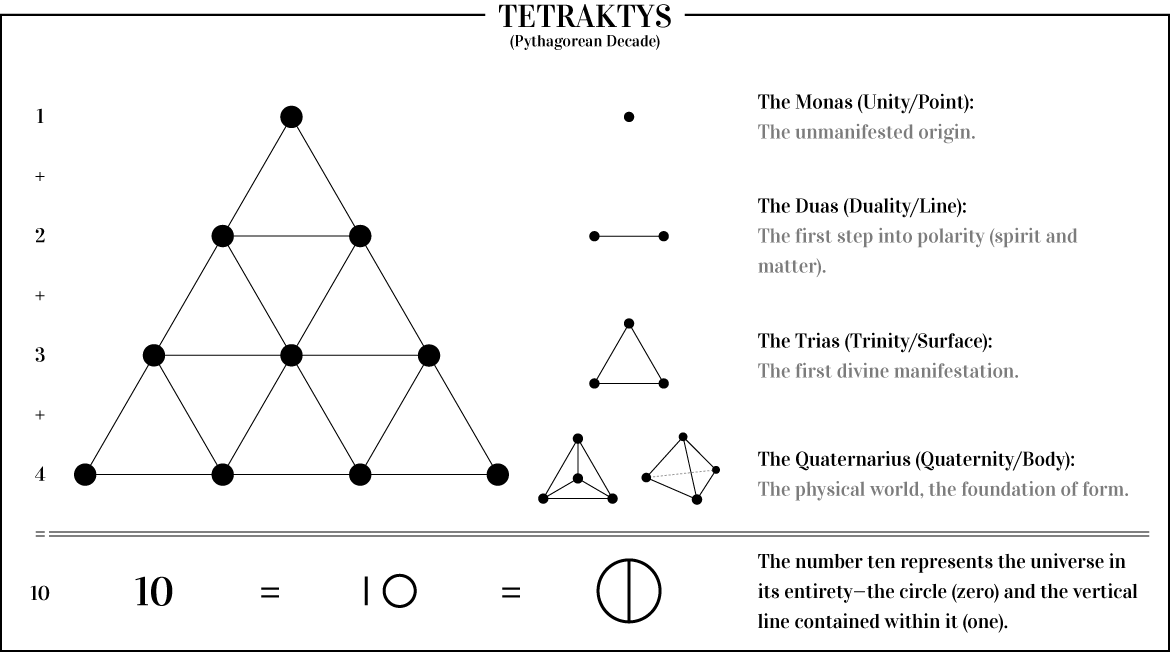
They are the mathematical and geometric heart of occult symbolism. Neither the cross nor the number ten are arbitrary inventions. Rather, they represent the fundamental blueprints through which spirit clothes itself in matter.
The number ten is considered a cosmic seal
The Pythagorean Decade, the sacred ten, is regarded as the “perfect measure.” It is encapsulated in the Tetraktys, a triangle of ten points (1 + 2 + 3 + 4 = 10), which holds within itself all the mysteries of the cosmos.
The Decade represents the entire cycle of evolution:
- The Monas (Unity/Point): The unmanifested origin.
- The Duas (Duality/Line): The first step into polarity (spirit and matter).
- The Trias (Trinity/Surface): The first divine manifestation.
- The Quaternarius (Quaternity/Body): The physical world, the foundation of form.
The number ten represents the universe in its entirety—the circle (zero) and the vertical line contained within it (one).
„The Decade or perfect number among the Pythagoreans … was the most sacred of all as it was the number of the entire Kosmos.“
The Cross as a Diagram of Evolution
In this chapter, the cross is reestablished as a universal symbol representing the union of spirit and matter. Long before it became a symbol of Christianity, it was the sign of anthropogenesis. The vertical beam represents spirit (Purusha), which descends into the horizontal beam representing matter (Prakriti).
A central concept is the “World Cross,” to which the Logos (the divine spirit) was nailed. This was not an act of punishment but rather the Spirit’s voluntary binding to matter in order to develop consciousness. Man himself is this cross, a spiritual being “crucified” in the fourfold world of the elements.
The Mystery of the Unfolded Cube
A cube has six faces. When these faces are spread out on a plane, they form a cross known as the Latin cross.
This is the occult meaning of the cross—it is the “unfolded cube.” The cube symbolizes the material, three-dimensional world. The cross reveals the hidden dimensions of the spirit within the form by unfolding this cube.
„The cross is the cube unfolded in every direction. It is the symbol of the manifested man, the ‘Heavenly Man’ or the Logos.“
The Purification of the Symbol from Phallicism
As in the previous chapters, Blavatsky warns against the “degradation” of these symbols here as well. She criticizes those who interpret the cross as merely a phallic symbol of fertility. While she acknowledges that it does possess this meaning of procreation at the lowest, physiological level, she emphasizes that this is only the “shadow” of the actual truth. The true cross is the instrument of regeneration, or rebirth, and not merely generation, or procreation.
Man is the living Tetraktys and the walking cross. The Decade is the goal of our development. It is the return to unity through the complete mastery of the fourfold material nature. With this knowledge, we recognize the geometry of the soul. Our lives follow precise, cyclical, and mathematical laws.
We must overcome the “crucifixion” and learn to let the spiritual principle within us—the vertical beam—triumph over material influences—the horizontal beam. Self-knowledge means uniting these principles by finding the point at the center of the cross—that place of stillness where spirit and matter become one.
Only those who master the meaning of the “Holy Four” (the Quaternarius) within themselves can ascend the steps of the Decade and find their way back to the divine origin. Thus, the cross is not the end, but the gateway to the infinite Decade of Light.
Mysteries of the Hebdomad (The Number Seven)
Chapter 25 (SD II) shows that the number seven is more than just a religious symbol. It represents the fundamental law of evolution and the structure of the cosmos and humanity.
The Omnipresence of the Heptad
In every ancient text, the heptad is considered the holiest number. It is the number of completion in the world of manifestation. While the triad (3) represents the unmanifested spirit, the heptad (3 + 4) represents the union of spirit and matter (the quaternary).
This number governs the rhythms of nature, from the seven colors of the prism and the seven tones of the musical scale to the seven stages of human gestation.
Saptaparna: The Seven-Leaved Human
A central symbol of this chapter is Saptaparna, the seven-leaved lotus or the plant with seven leaves. In occult terminology, this term stands for the human being in his sevenfold constitution. Blavatsky emphasizes that the human being is not a “dual being” consisting of body and soul, but a complex system of seven principles:
1. Atman (Spirit)
2. Buddhi (Spiritual Soul)
3. Manas (Intellect/Mind)
4. Kama Rupa (Desire Body)
5. Linga Sharira (Astral Body/Model Body)
6. Prana (Life Principle)
7. Sthula Sharira (physical body)
(See “The Great Duality: The Immortal Triad and the Mortal Quartet” under “Being Human”)
This represents the exact correspondence to the seven levels of the cosmos.
The Seven Rishis and Astronomical Symbolism
The Sapta Rishis, the seven holy seers of India, also form a septet. They function both in the heavens as the constellation “Great Bear” and in the history of humanity as spiritual guides of the races.
„The number seven is the number of the ‘Host’ (the Dhyan Chohans) … it is the seal of the ‘Seven Spirits’ who stand before the throne of the manifest Logos.“
Each of these seven spirits governs one of the seven chains, seven rounds, and seven root races of our Earth chain. This illustrates the close intertwining of astronomy, geology, and anthropology in the Secret Doctrine.
The “Seven Souls” of Egypt
The Egyptians were familiar with the seven principles of human beings millennia before modern science. They called these principles the “Seven Souls,” or stages of existence ranging from the physical form to the divine Khu (spirit).
The Esoteric Meaning of the Sabbath
There is also an occult interpretation of the Sabbath. The seventh day represents not only physical rest but also symbolizes the state of Pralaya, the cosmic rest, to which everything returns after the cycle of sevenfold manifestation. It represents the point of synthesis where the “many” become one again with the “One.”
The knowledge of the Seven teaches that the human being is a “miniature universe” structured according to the Law of Seven. Understanding the hebdomad is the key to harmonizing one’s own nature. We must develop all seven levels—the wholeness of our being—and not just the intellectual or physical level.
Life unfolds in cycles of seven. Those who recognize this rhythm can act in harmony with the law of karma. It leads us to the realization that everything in nature is interconnected—from the stars to the atoms.
Seven is the “magic number” of initiation. Only those who unravel the mysteries of the Hebdomad within themselves can take the eighth step and attain the boundless freedom of the absolute spirit.
The Deeper Meaning of the Study of Symbolism
Symbolism is the direct, condensed essence of all theosophical teachings. The law of karma, the doctrine of reincarnation, the sevenfold nature of the cosmos (the septenary system), and the inexorable process of evolution are enshrined in geometric forms such as the circle, the cross, and the triangle. Thus, the cross signifies the fall of the spirit into matter, while the World Egg conceals the law of cyclic rebirth.
Studying this symbolism is the best protection against dogmatism, blind faith, and materialism. H. P. Blavatsky emphasizes that the profaned, literal interpretation of ancient scriptures caused the sublime ideals of antiquity to degenerate into crude, phallic, and anthropomorphic idols. This section teaches us to look beyond form—the husk of the dead letter—and grasp the “soul of things.” Without the key of analogy and correspondence, occult progress is impossible because the mind remains trapped in the labyrinth of literal translations.
The Maha Chohan teaches that pursuing occult knowledge exclusively for one’s own progress, even for attaining Nirvana, is a form of “sublime egoism.” When, through the evolution of symbolism, we recognize that all world religions have identical roots in the one great religion of wisdom and that the Divine is equally present in every atom, then the dividing walls of dogma, racism, and nationalism crumble. The study of symbolism proves, on a scientific and historical basis, the spiritual kinship of all peoples and even of all beings. Only when this universal understanding enlightens the mind can compassion (the “Doctrine of the Heart”) truly unfold and the universal brotherhood demanded by the Masters be realized on Earth.
The “Evolution of Symbolism” in the Secret Doctrine is the living, timeless testimony of the soul of humanity. It is Ariadne’s thread, guiding us through the labyrinth of exoteric dogmas back to our spiritual homeland. Those who devote themselves to this study with a keen mind and a loving heart transform abstract philosophy into living alchemy. They learn to read the history of the cosmos and find the path by which finite, erring humanity returns to the heart of infinity.
(Blavatsky)