
This article provides a comprehensive overview of the Addenda from Volume I and Volume II of The Secret Doctrine, examining the historical tension and ultimate synthesis between esoteric philosophy and modern scientific inquiry. It explores the relationship between ancient occultism and the development of physics and chemistry, highlighting how spiritual principles often anticipate empirical discoveries. This concise analysis offers clarity for both students of theosophy and researchers looking to bridge the gap between science and metaphysical tradition.
Table of Contents
General Introduction
Once the sincere seeker has navigated the deep metaphysical waters of the ‘Secret Doctrine’, they inevitably face the challenging task of anchoring this intuitive, universal knowledge in the world of forms and scientific phenomena. The third part of the first and second volumes, titled ‘Science and the Secret Doctrine Contrasted’, provides precisely this decisive touchstone. It is the intellectual arena in which ancient wisdom religion fearlessly confronts the dogmatic, materialistic science of our time. The following examination serves as a comprehensive guide to the section’s core themes and prepares the mind to bridge the apparent gap between science and Theosophy.
To grasp the third part of The Secret Doctrine, it is important to recognise that H. P. Blavatsky is entering the spiritual battlefield of her time. While the preceding parts lay the metaphysical, cosmogonic and symbolic foundations, this section represents the intellectual execution of a strategic mission formulated in the seminal 1881 letter from the Maha Chohan. It serves as a necessary bridge between eternal wisdom and limited, fleeting knowledge, and provides occult theories with the backing of exact science.
Without the scientific section, theosophical teachings risk being dismissed by the modern reader as mere ‘metaphysical daydreams’ if they are not considered in light of contemporary physical discoveries. The ‘modern mind’ is so deeply entrenched in materialistic dogmas that a rational dismantling of these dogmas is required for it to become receptive to esoteric teachings.
For serious seekers, this section is essential as it frees the mind from purely physical explanatory models, creating space for an occult perspective in which spirit and matter are inseparably interwoven. Anyone seeking self-knowledge must first overcome materialism in their own thinking.
The student learns to distinguish between timeless principles and time-bound human theories. Blavatsky urges us not to blindly follow religious or scientific authorities, but to examine the logic of nature itself.
A key aspect of this subject is the difference between what science refers to as laws and what the Secret Doctrine refers to as the workings of intelligent forces. Blavatsky argues that science exclusively deals with ‘secondary causes’, i.e. visible effects and mechanical processes. However, the ‘primary causes’, the actual source of force and motion, remain hidden from exact research since they exist on planes beyond the reach of the physical senses.
She compares scientists to people who observe shadows on a wall but ignore the light source and the objects casting the shadows.
The following two quotes aptly summarise this idea:
“Science is before a dead wall, on which her art can paint only delusive masks.”
“Modern science is a very young lady, and she has to be corrected.”
This “correction” consists of demonstrating that science excels at describing the “how,” but fails miserably when it comes to the “why.” The aim is not to discredit science itself, but to expose its dogmatic materialism, which reduces living nature to a mere machine. Blavatsky was confronted with the arrogance of the science of her time, which claimed to have already discovered the definitive laws of nature. She contrasts this with the concept of an ‘occult science’ that views the physical world as merely the outer shell of a far more complex and sublime reality.
The Addenda are intended to demonstrate that occult teachings possess knowledge that fills the gaps in scientific hypotheses. Blavatsky emphasizes that science will never solve the mysteries of gravity, light or electricity as long as it refuses to acknowledge the existence of an ‘etheric’ or ‘astral’ plane.
What follows is a coherent presentation of this significant section, which serves as a link between ancient esoteric knowledge and modern academic knowledge. Additionally, we outline the current state of science and compare it with that of the 19th century. From the perspective of the 21st century, a striking convergence becomes apparent: the ‘dead wall’ that 19th-century science faced has today developed deep cracks through which spiritual reality is increasingly shining through.
Addenda Cosmogenesis
The Relationship of the Three Parts of Cosmogenesis
To grasp the significance of this third part, one must understand its organic and strategic relationship to the two preceding parts. Here we can see how each part perfectly reflects humanity’s approach to the truth:
Part I (‘Cosmic Evolution’): The ontological “what.” It reveals the spiritual genesis of the cosmos through the archaic stanzas of the Dzyan. It provides the formless blueprint and describes the gradual emanation of the divine into existence.
Part II (‘The Evolution of Symbolism in its Approximate Order’): The epistemological “why.” It translates this theogony into the universal language of the mysteries, showing how early human civilisations encoded these truths in sacred symbols and ideograms for posterity.
Part III (“Science and the Secret Doctrine Contrasted”): The empirical How. It serves as a necessary bridge to the modern world and as a defence. Helena P. Blavatsky recognised that esoteric teachings postulating conscious spiritual forces behind all natural processes fundamentally contradict the materialist paradigms of modern natural science, and would therefore inevitably be met with ridicule and rejection.
While Part I describes the macrocosm from the perspective of the spirit and Part II deciphers the soul of ancient wisdom, Part III addresses the physical mind.
It demonstrates that orthodox science neglects the deductive method of deriving from the general (the universals) to the particular, and instead attempts to solve the mysteries of existence purely inductively, starting from isolated physical phenomena. Part III proves that a science which ignores the guiding pole of the spirit can never solve the riddle of the world. At the same time, it prepares the ground for a deeper synthesis.
Blavatsky justifies the necessity of engaging with the science of her time, not to prove herself right, but to demonstrate that the Secret Doctrine is not an isolated teaching, but rather universal knowledge towards which all true discoveries, whether physical or spiritual, inevitably converge. The truth of nature cannot contradict the truth of the spirit. They are merely two aspects of the same reality.
Introduction to the Addenda of Cosmogenesis
In the first chapter of the third part, Blavatsky notes that some Western theosophists had expressed concerns. They feared that the occult teachings might be perceived as deficient from the perspective of modern science. To contradict the teachings of its most eminent exponents would be tantamount to courting premature defeat: “to run counter to the teachings of its most eminent exponents, was to court a premature discomfiture in the eyes of the Western World”.
Blavatsky addresses these concerns by clearly defining her position. She emphasises that Theosophy is by no means hostile to science. On the contrary, as long as science remains what Thomas H. Huxley calls ‘organized common sense’, and its conclusions are based on irrefutable facts and a purely inductive foundation, Theosophists and occultists respectfully welcome these findings. There is no inherent conflict between occult teachings and so-called exact science as long as the latter remains within its legitimate sphere.
“People have laughed at everything and scouted every unpopular idea at first, and then ended by accepting it”.
(Blavatsky)
The real conflict only flares up when scientists overstep their boundaries. This occurs when they attempt “to penetrate into the Arcana of Being” (deep mysteries of being) and attribute the origin of the cosmos and its living forces exclusively to blind matter, completely excluding the spirit. In such cases, the occultist reserves the right to question and challenge these theories. Blavatsky begins her analysis by noting that modern physicists often play an intellectual game of ‘blind man’s bluff’.
Since official science attempts to explain the creation of the world solely through blind, dead matter, relying only on physical apparatus and the five senses instead of recognising cosmic thought as the primary driving force, it becomes embroiled in insoluble contradictions.
Scientific authorities cannot even agree on the true essence of light, matter, the atom or force, and constantly produce mutually contradictory hypotheses.
Gravity and Magnetism
Blavatsky argues that the most celebrated discoveries and theories of modern science are, at their core, merely distorted echoes of ancient wisdom. Materialistic science postulates the absolute primacy of gravity, reducing light, heat and magnetism to mere modes of matter’s motion.
Esoteric philosophy counters this by asserting that behind all these mechanical and physical phenomena lie conscious, guiding intelligences, not blind laws. These formative powers (Builders) and planetary spirits (Dhyan Chohans) direct the primordial energy known in occult science as Fohat — the dynamic bridge between divine thought and cosmic substance that executes the law of creation in matter. When science speaks of ‘attraction’, it is actually describing the sympathetic resonance between living monads.
A central theme is the redefinition of matter. At that time, the atom was considered an indivisible, dead particle by science. However, The Secret Doctrine asserts that there is no such thing as ‘inorganic’ or ‘dead’ matter in the universe. Therefore, the atom is not a solid particle, but rather a ‘center of energy’ and a ‘repository of consciousness’. At its innermost core, the atom is a living, immortal entity permeated by a spiritual monad — a ‘divine spark’ — which undergoes its own cyclical evolution through countless forms, from mineral to deity.
Gods, monads and atoms are not separate realities, but an inseparable graded unity. Through this, the one infinite Spirit individualizes and experiences itself in the manifested cosmos. This perspective transforms the universe from a machine into a ‘divine spectacle’.
Here, Blavatsky reconciles Leibniz’s doctrine of monads with Eastern esotericism, referring to visionary chemists such as Sir William Crookes. Crookes’ concept of the ‘protyle’ came remarkably close to the theosophical doctrine of Mulaprakriti (primordial substance) — that homogeneous matter from which the world has developed through differentiation.
This assertion was dismissed as mysticism at the time, but has since been confirmed by modern quantum field theory. Today, particles are no longer understood as solid objects, but as local excitations of an underlying field that permeates all of space. Physical form is thus revealed to be a mask (Maya) for dynamic, energetic processes. The modern discovery of the Higgs field, which gives particles their mass, reflects the concept of the protyle almost identically: an invisible, primordial unity from which the diversity of differentiated material phenomena emerges.
Akasha, Ether, and the Quantum Vacuum
Similarly, John Worrell Keely’s research on the etheric force and interetheric waves demonstrates that scientific pioneers are gradually uncovering those subtle energies familiar to the initiated for countless cycles.
At that time, the science postulated the ether merely as a mechanical medium for light waves. Blavatsky corrected this notion by describing the ether as the gross, physical shell of Akasha, the spiritual light-bearer that acts informatively, not mechanically. Akasha is the spiritual counterpart, the “light-bearer” in the metaphysical sense, in which all past, present, and future events are imprinted.
Without an understanding of this occult electricity, known as Fohat, any physical theory remains incomplete.
Although the concept of the ether has officially disappeared from modern physics, the concepts of zero-point energy and dark energy have taken its place. The quantum vacuum is no longer understood as a void but as a reservoir of infinite potential. Cosmology’s realization that 95% of the universe consists of invisible dark matter and energy confirms the occult assertion that the visible world is merely the “crust” of a far more complex, invisible reality.
The Sun as a Pulsating Heart
Even the nebular hypothesis of Kant and Laplace, popular at the time, proves, upon esoteric examination, to be merely a rudimentary and incomplete chapter of the much older occult cosmogony. Blavatsky builds upon the purely mechanical hypothesis, describing the image of the “Sun as the heart of the system.” To her, the sun is not a burning ball of gas but rather a repository of life force (jiva) that pulses rhythmically throughout the entire system.
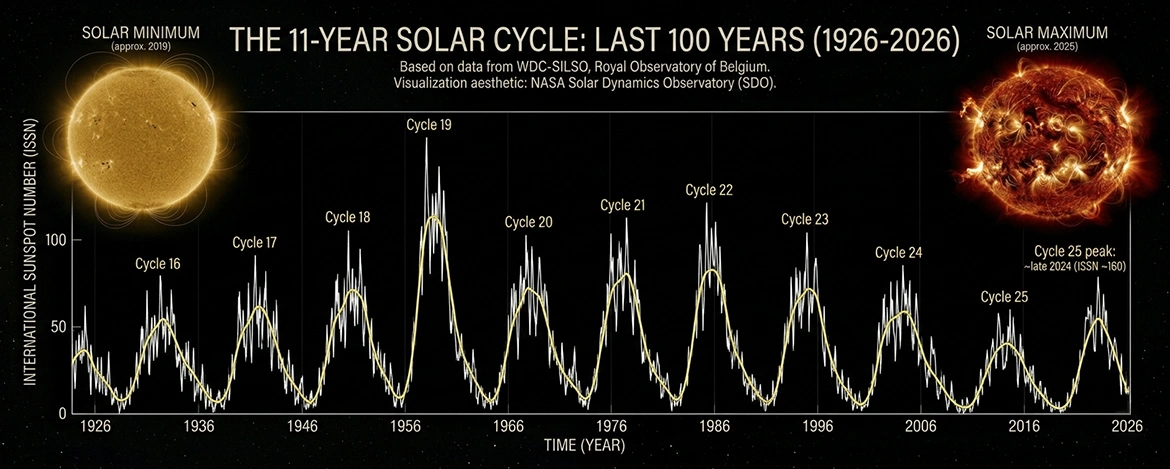
Modern helioseismology has since discovered that the sun is indeed subject to rhythmic oscillations and vibrations. Like a living organ, it breathes in eleven-year cycles and influences the entire energetic climate of the solar system through its electromagnetic emissions. Thus, the static models of the past are increasingly giving way to a picture depicting a highly complex, dynamic, and almost “biologically” appearing system.
Summary of the Key Points of the Addenda in Cosmogenesis
In conclusion, we summarize the core of these scientific addenda from Volume I (Cosmogenesis) in four key points that define the theosophical position in relation to materialism.
1. The Oneness of Consciousness: There is no such thing as “dead matter.” Everything in the universe, from the atom to the star, possesses its own degree of consciousness corresponding to its respective stage of development.
2. The identity of mind and matter: Matter is condensed mind, and mind is the subtlest form of matter. Both are aspects of the one “Primordial Substance.”
3. The Universality of Law: The Law of Analogy—”As above, so below”—is the universal key. What applies in the macrocosm must be reflected in the microcosm.
4. The evolution of intelligence: Behind every force of nature stand intelligent beings. The “blind laws” of science are, in truth, the mechanisms of action of the Dhyan Chohans, the conscious architects of the cosmos.
(Klaus Schmidt, Excavator of Göbekli Tepe)
Addenda Anthropogenesis
The Relationship of the Three Parts of Anthropogenesis
Before summarizing the addenda from Volume II, let us briefly examine the relationships between its three parts to better understand the function of the third part.
Part I (Anthropogenesis) reveals the occult history of humanity’s origins through the stanzas of the Dzyan: the descent of the lunar ancestors (Lunar Pitris) and the awakening of the thought principle through the Manasaputras (Sons of Wisdom).
Part II (“The Archaic Symbolism of the World-Religions”) translates these processes into the universal language of symbols, showing how these metaphysical facts are expressed in myths and religions. Examples include the Garden of Eden, Prometheus, fallen angels, and more.
Part III (“Addenda”) serves as the necessary defense and intellectual bridge. Since occult teachings speak of a polygenetic origin story, the existence of giants, and animals emerging from humans, they conflict with materialistic science. This section leaves the protective realm of symbolism behind and confronts science on its own terrain of anatomy, biology, and paleontology.
Introduction to the Addenda on Anthropogenesis
In the second volume, the focus shifts from cosmology to anthropology. The addenda serve as an intellectual bulwark against Darwin’s “struggle for existence,” which the Maha Chohan identified as the root of nearly all human suffering.
Here, we provide an overview of this multifaceted theme to prepare readers to bridge the gap between humanity’s divine heritage and modern, fossil-based hypotheses.
Blavatsky organizes the addenda in a logical sequence, ranging from a general critique of evolutionary theory to concrete evidence of sunken continents. In doing so, she reveals that so-called “facts” are often merely interpretations. Without realizing that humanity is a spiritual reflection of the cosmos, all self-knowledge remains superficial. This frees the mind from the notion that we are merely “advanced apes.”
Archaic or Modern Anthropology?
Haeckel’s radical materialism
The section begins with the fundamental question of our ancestors. Blavatsky contrasts the esoteric teaching of divine ancestors with the materialistic theory of descent. The latter reduces humanity to a gelatinous primordial slime: the Bathybius haeckelii, a gelatinous deep-sea substance postulated by Ernst Haeckel.
The Secret Doctrine decisively rejects Haeckel’s radical materialism. This theory reduces consciousness and the soul to mere byproducts of a cell. The text demonstrates that modern Darwinism only grasps evolution halfway (“at its midway point”), when astral evolution has already given way to physical evolution.
In Contrast to Darwinism
A central point of conflict, and arguably the most controversial topic, is the sequence of evolution. Materialistic science posits that humans evolved from the animal kingdom, specifically from catarrhine apes. However, theosophical phylogeny teaches the exact opposite: in this fourth round, humans appeared first.
Today’s mammals are the result of physical prototypes shed by early humans who were still mindless. Therefore, the ape is not an ancestor of humans but rather the degenerate product of an unnatural union between early human-like races (the third root race) and animal species.
Esotericism does not deny natural selection but rather regards it as only a secondary, purely physical law. The true driving force behind the formation of forms is the intelligent “Dhyan-Chohanic Impulse,” which guides evolution from behind the scenes. Nineteenth-century science searched in vain for the “missing link.” Blavatsky argued that it would never be found since early evolution took place on etheric planes.
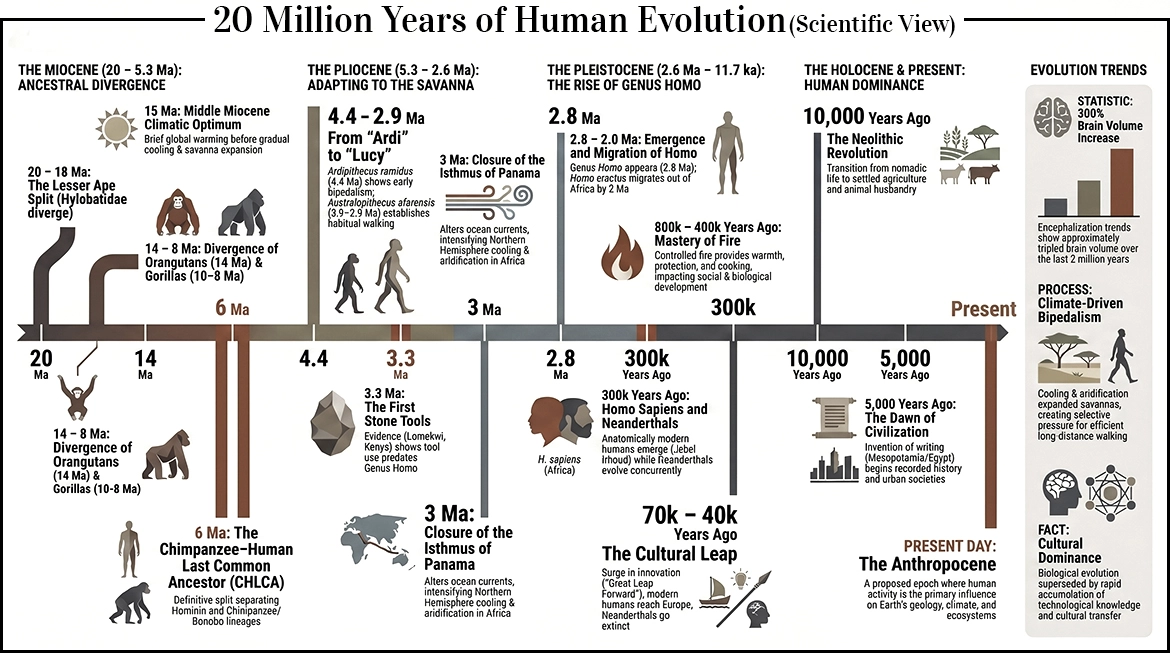
Modern 21st-century paleoanthropology is slowly embracing this complex perspective. Thus, today, the human family tree is no longer understood as a simple line but as a “braided stream,” characterized by constant intermingling and nonlinear developments.
The Triple Evolution
Blavatsky accepts the principle of evolution, but rejects pure chance. She introduces the concept of “Creative Centres.” She describes evolution as a dual process: physical evolution from the bottom up intersected by spiritual involution from the top down.
As we have previously demonstrated in Anthropogenesis (“The Three Streams of Evolution”), a third evolution exists: the intellectual or manasic evolution. Humanity is the result of the convergence of these three evolutionary streams. “Natural selection” is regarded as a subordinate force, subject to the intelligent inner guidance of nature.
Geological Chronology and the Antiquity of Civilization
A significant portion is devoted to chronology. At that time, the orthodox geology and anthropology allotted only a tiny span of time to human existence. Blavatsky contrasts the geological periods of science—the Primary, Secondary, and Tertiary periods—with the “parallelism of life” of theosophical chronology and its calculations of Yugas and Kalpas.
She demonstrates that esoteric time periods, which allow for millions of years for each race, are far more logical. She also shows that physical humanity must have existed long before the time postulated by science, in the late Secondary or early Tertiary era. The discussion of geological periods makes room for the history of the four preceding root races.
Esoteric evolutionary history goes back even further with the doctrine of planetary chains. This deconstructs the anthropocentric arrogance of Western theology and science. According to The Secret Doctrine, every visible celestial body is part of a sevenfold chain of worlds. This teaching explains how life impulses pass from a dying planet, such as the Moon, to a new planet, such as Earth, placing the evolution of humanity within a vast interplanetary context.
While science has attributed only a few thousand years of civilization to humanity, discoveries such as Göbekli Tepe have drastically altered this perception in modern times. Monumental sacred structures, erected over 11,000 years ago—long before the advent of agriculture—demonstrate that spiritual impulses preceded physical settlements. This lends support to the theosophical teaching that spiritual development, not purely material necessity, is the driving force of evolution.
The Giants and the Sunken Continents
In order to substantiate the theosophical doctrine of successive Root Races, their geographical homelands must be identified. Blavatsky cites extensive evidence from paleontology, geology, and botany to show that the distribution of flora and fauna can be explained only by former land bridges and sunken continents. Accordingly, vast landmasses—Lemuria in the Pacific and Atlantis in the Atlantic—were cyclically destroyed by volcanic fire and oceanic floods.
Thus, the constant shift of the Earth’s axis and the redistribution of land and water are not myths, but karmic necessities for renewing the Earth’s crust and its races.
Furthermore, Blavatsky speaks of the giants of earlier races, making it clear that they were biological realities, not mythological inventions, subject to the cyclical laws of incarnation.
Summary of Key Points in Anthropology
We conclude this anthropology overview by summarizing the key points that form the core of these scientific addenda from Volume II and define the theosophical position in relation to materialistic science. The essential pillars upon which the doctrine of the origin of man in the Secret Doctrine rests are as follows:
The Priority of Spirit over Matter: Evolution does not begin with matter laboriously “ascending” to consciousness. Rather, physical evolution is preceded by an involution of the spirit. Man is a spiritual monad by nature that descends into denser layers of matter to gather experience. The physical body is merely the last and least significant link in this chain.
The Rejection of the Ape-Ancestry: While Darwinism views humanity as “highly evolved apes,” the Secret Doctrine teaches that humanity represents the primary form. Today’s human-like apes (anthropoids) are the result of degeneration; they are the descendants of unnatural unions between earlier human races that were not yet fully individualized and animal forms during the third root race. The ape follows man, not the other way around.
The vast Antiquity of Man: Humanity as a physical species has existed for millions of years, not just tens of thousands. This chronology is embedded within the cycles of the seven root races. Earlier continents, such as Lemuria and Atlantis, were the settings for this history spanning millions of years.
The Intelligent Guidance of Evolution: Occult teachings reject “blind chance” and the sole power of “natural selection.” Rather, evolution is a planned process guided by spiritual hierarchies known as the Dhyan Chohans. These hierarchies provide the “ideals” or “astral prototypes” that shape physical form. Nature is not a clockwork mechanism but a living expression of divine intelligence.
The Law of Analogy: This postulate is the most important tool for students: “As above, so below.” Man is a microcosm that contains all the principles and forces of the macrocosm within himself. The development of a child in the womb, the evolution of a race, and the formation of a solar system all follow the same basic pattern.
The Septenary Nature of Man: Unlike science, which reduces human beings to their physiology, the Secret Doctrine posits that human beings are a unity of seven principles. No biological theory can fully grasp human beings if it ignores higher principles, such as Manas (mind) or Buddhi (spiritual ego). The physical body is merely a mask (persona) of the true, immortal self.
Retrospective, Outlook, and Invitation
We recall the mandate of the Maha Chohan, which forms the heart of the Theosophical strategy:
“The doctrine we promulgate being the only true one, must, — supported by such evidence as we are preparing to give become ultimately triumphant as every other truth. Yet it is absolutely necessary to inculcate it gradually enforcing its theories, unimpeachable facts for those who know, with direct inferences deducted from and corroborated by the evidence furnished by modern exact science.”
In retrospect, it’s evident that H. P. Blavatsky and her two masters, Morya and Koot Hoomi, masterfully achieved this noble aspiration with The Secret Doctrine. They created a monumental work of esoteric teaching and performed the necessary pioneering work to expose the barriers of materialistic science that still stand in the way of a genuine synthesis of spirit and matter.
Approximately 150 years have passed since these words were written—a period during which humanity has made enormous technological advances yet taken only tentative steps toward self-knowledge (Atma-Vidya). The occult insight that truth can be imparted to the collective consciousness only “sip by sip” to avoid intellectual or moral overload is proving true.
Despite the slowness of this process and the tenacity of Maya (illusion), which clouds our vision, the Maha Chohan’s promise remains. Since the teaching is based on the eternal laws of nature, truth will ultimately triumph over every time-bound error. This hope is the anchor for every serious seeker on the path.
We wish to fulfill the Maha Chohan’s mission and contribute to it. To this end, we will present specific scientists, theories, and research findings from the 20th and 21st centuries in an ongoing series of detailed articles. These analyses will illustrate the core tenets of the Secret Doctrine and place them on a solid, contemporary scientific foundation.
In doing so, we will transcend the boundaries of conventional specialization and bring together insights from a variety of fields:
- Physics and chemistry: Investigation of the energetic foundations of matter and the alchemy of the elements.
- Mathematics: Exploration of fractal geometry and sacred numerical ratios as the blueprint of the cosmos.
- Biology and anthropology: Reassessing evolutionary mechanisms and the true origin of humanity beyond purely mechanistic models.
- Archaeology: Documenting advanced prehistoric civilizations that redefine the age of civilization.
- Psychology and Consciousness Research: Integrating the occult constitution of humanity into our understanding of the human psyche.
Our work aims to make theosophical teachings understandable and accessible. It also serves as a direct call to today’s scientists. We encourage researchers to incorporate the theories and insights of archaic science into their work. Often, this timeless wisdom provides the necessary impetus to view previously unsolved mysteries, whether in cosmology, genetics, or particle physics, from a new, expanded perspective, thereby inspiring groundbreaking innovations.
Conclusion: The Alchemy of Science, Ethics, and Brotherhood
Blavatsky concludes the chapter on a prophetic note. She predicts that science will reach a point where it must acknowledge its own limitations. When instruments can no longer be refined, humanity itself must become the instrument of research. This marks the transition from exact to occult science. This scientific shift does not signify a definitive break, but rather an invitation. Occultism offers science the “spiritual causes” as missing puzzle pieces to complete the picture of reality.
“Science and the Secret Doctrine Contrasted” is the methodological response to the call for a spiritual transformation of humanity. This work is an alchemical vessel that purifies the intellect of modernity with the fire of archaic wisdom. By exposing the half-truths of material research and replacing them with the laws of cyclical, intelligently guided evolution, Blavatsky creates a system that harmonizes the mind and the heart. When modern science casts off its dogmatic shackles and becomes intuitive, it does not contradict esotericism; rather, it is destined to confirm and justify its most sublime truths on the physical plane.
Why is this juxtaposition crucial for the path of self-knowledge? First, it proves that the Masters of Wisdom, who have attained self-knowledge, understand physical matter as precisely as they understand the spiritual spheres. On the other hand, approaching esoteric truths only in the form of poetic myths or abstract metaphysical concepts risks slipping into blind faith or baseless “psychic craze.” This is unworthy of science and religion alike. This section of the book trains the lower mind (Manas) by forcing the intellect to distinguish and analyze with razor-sharp precision. Archaic axioms must be considered alongside modern hypotheses so discerning readers can compare and judge for themselves.
The extent to which occult teachings diverge from “real science” must be demonstrated, as well as whether ancient theories are ultimately more logical and philosophically sound than modern speculations. True Theo-Sophia is not an attempt to escape into abstract mysticism or invented fantasy. Rather, it is the deepest, most universal science of reality, piercing through the illusions (Maya) of mere superficial observation.
When the student realizes that exact science repeatedly encounters insurmountable limits through its purely inductive method and ignorance of spiritual forces, he acquires the philosophical tools to logically and coherently defend occult teachings. This section establishes the foundation of esotericism. It teaches us that spirit and matter are not irreconcilable opposites but two facets of one universal reality that endlessly transform.
Blavatsky also clarifies that our self-perception is inextricably linked to our worldview. Those who believe they live in a dead universe will view themselves as a random product of evolution and adopt the nihilistic worldview of crude materialism. However, those who recognize that the entire cosmos is a living whole grasp their responsibility as part of this stream of consciousness. They understand that human dignity is not based on physical superiority but on our divine origin.
This forms the foundation for all further detailed studies because it refutes the doubts that the materialistic age has instilled in us. It reminds us that we are “monads in exile,” wandering through the cycles of time, destined to return to our spiritual source. True science must therefore be linked to ethics and service to the whole. Brotherhood among humanity is not a sentimental notion but a cosmic law that paves the way for the bodhisattva ideal of working for the welfare of all beings, guided by the realization of one indivisible truth.
True science is religion, and true religion is scientific. Both find their point of union in the truth that stands above all systems.
“There is no religion higher than truth” (Satyat Nasti Paro Dharmah).
We now have the foundation to cross the bridge between worldly knowledge and the wisdom of adepts.
(Isis Unveiled, Blavatsky)